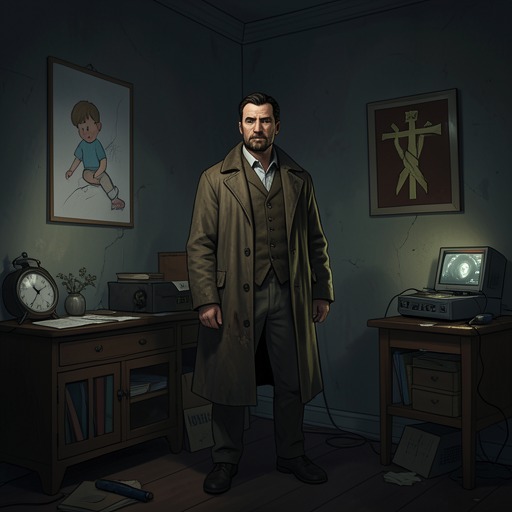
Father Guglielmo
I Know This Much Is TrueFather Guglielmo is a Catholic priest in Three Rivers whose story turns on two forms of service: building a parish school and helping Domenico Tempesta confront the buried history of his life. First presented as a subordinate who failed to intervene when Domenico’s brother was mocked, he later seeks reconciliation, offers religious guidance in confession, and gives Domenico a penance that becomes the occasion for his life-writing. His authority is neither effortless nor detached; it is marked by an acknowledged past failure and by the persistence of his counsel after he leaves the parish.
Identity and Parish Leadership
After Monsignor McNulty dies of a bad heart, Father Guglielmo is named acting pastor of St. Mary of Jesus Christ Church. Domenico recalls being pleased both by McNulty’s death and by Guglielmo’s promotion. In his view, Guglielmo had not been an opponent so much as McNulty’s “whipped dog,” a priest whose earlier weakness had left him on the wrong side of a painful family history.
As pastor, Father Guglielmo pursues a long-standing plan to establish a parochial school. Catholic children from Three Rivers have had to board in New London during the week, separating them from their families; the archbishop has now approved a school, and an architect and builder from Hartford have been hired. Because the project must be sound and economical, Guglielmo approaches Domenico, a knowledgeable parishioner, to supervise construction and represent the parish’s interests. He admits that he lacks expertise in those areas and that the school’s success will stand as testimony to his stewardship. The request makes his leadership concrete: he is responsible for a public undertaking, but must depend on a parishioner’s skill to carry it out.
A Belated Attempt at Reconciliation
The school visit also brings Father Guglielmo back into contact with Domenico after years of distance. He recalls the day Domenico’s brother fell from the roof as terrible for everyone involved, including himself and Monsignor McNulty. McNulty, Guglielmo says, regretted mocking the brother and sought God’s forgiveness before his death; Guglielmo, too, regrets that he did not intervene as he believes God would have wanted.
In the kitchen, Guglielmo asks Domenico to meet his eyes and offers an olive branch, asking him to let the past go and forgive him. Domenico rejects the appeal sharply. The mention of brothers turns the attempted reconciliation back toward his losses: one brother was shot by police, and the other, in his account, was driven from the roof by a monsignor’s curse. He also refuses to treat the school project as a reason to forgive, pointing out that the parish can hire other bricklayers. The exchange does not instantly repair their relationship, but Guglielmo’s admission matters: he names his failure to act instead of presenting himself as blameless, and asks forgiveness as a brother would.
Confession and the Stillborn Child
Father Guglielmo’s most consequential pastoral act comes when Domenico confesses that he secretly baptized his stillborn son. He distinguishes serving God from presuming to take God’s place, then directly reassures Domenico that he did not damn the child. The baptism, he tells him, delivered the boy from limbo and placed him in the care of Jesus Christ; it was valid. Domenico’s breath catches, and he leans his head against the wall of the confessional. The ruling answers the fear at the heart of his confession with certainty rather than condemnation.
Guglielmo’s absolution does not end with reassurance. He assigns a two-part penance: Domenico is to pray the rosary daily for a month, reflecting on forgiveness and on the presence of holiness in women, and to write down everything he has spoken about his life. He instructs him to put the story in order—beginning, middle, and present—and to leave omertà by setting down his memories. For Guglielmo, the writing is a religious discipline meant to loosen the anger and pride that bind Domenico and teach humility. When Domenico objects that his English is better to read than to write, Guglielmo tells him that God understands every language; he may write in scholarly Italian or in the Sicilian dialect of his childhood. Good faith and completion matter more than the language.
The Counsel That Remains
Domenico protests that he works ten hours a day, maintains a home, and has responsibilities beyond the assignment. The later fragments of his account show the penance competing with those demands and with the force of remembered injuries. After a household crisis, he lies awake imagining that Guglielmo would tell him to forgive Prosperine, ask forgiveness himself, humble himself, and write everything down. His anticipated version of the priest’s counsel is not soothing: it presses him toward the very acts he resists.
Domenico also records that Guglielmo later moved to Bridgeport, and that he no longer knew whether the priest was alive or dead. Distance does not erase the remembered instruction. Recalling the priest’s words—“To be human is to be humble”—Domenico links confession, penance, and humility, even while admitting that he was never very good at confession. At the end of his manuscript he addresses Guglielmo directly, presenting the account as the confession and penance the priest had asked for and asking God to save his soul. Father Guglielmo’s lasting significance lies in this unfinished tension: his guidance gives Domenico a structure for telling the truth, but cannot make humility or forgiveness easy.